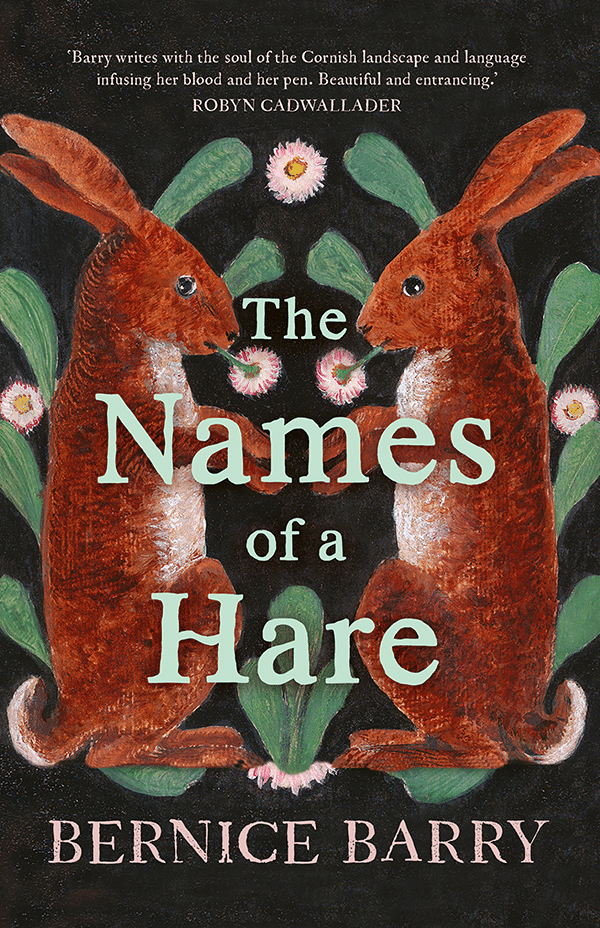
This month, a selection of our Beauty and Lace Club members are reading The Names of a Hare by Bernice Barry. The author took some time to answer some questions for us, and you can read her thoughts right here:
What aspect of The Names of a Hare do you think will generate the most book club conversation?
I know from reviews that readers are interested in the way women lived in the seventeenth century, and in exploring what the world was like for a neurodiverse person when it was so dangerous to be a bit different.
I think the broad discussion that happens at book clubs might focus on the magical aspects of the story. Did the spells really work, or was it just the natural healing properties of herbs? Was the main character really a witch, and did she fly, or can the events be explained in other ways? I’d like to hear some of the lively discussions!
How do you know when a good idea is enough for a novel?
I think you know when you have a good idea, but an idea isn’t usually enough on its own. It can take a long time to gather all the ingredients that blend to create a story with the complexity to maintain a reader’s interest right to the end.
In my experience, the bits come together by accident. An idea that’s been hanging around for months connects with things I hear or see quite randomly – perhaps a setting or a character. One day, it all fits together with a wonderful ‘click’ in your brain, and you realise an idea has developed into a potential story.
The back of the novel lists some very old texts that you used in your research. Where did you find them? And what did you discover in them that was useful for your writing?
Some are on my bookshelf, but most were found through Internet searches. The old herbals were such a rich source of information, and it was hard to decide what to leave out! I collected recipes for herbal remedies and used them in my writing, as well as old words and names for plants I’d never heard of.
The books gave me lots of ideas for scenes, like the one where Ned is being treated for muscle pain with a hot oat poultice. They also showed me how a herbalist spent her days, the everyday tasks, and the way her work changed through the seasons. I used all that in creating a sense of time and place.
Do you have a favourite book?
My favourite novel isn’t always the same one! I think enjoyment of fiction is closely linked to our own experience, so the book I loved most as a teen isn’t the same one I’d choose today. Of course, some books will always be special. I first read ‘Jane Eyre’ by Charlotte Brontë when I was nine and will never forget how it set my imagination on fire.
As an undergraduate student, I loved ‘The Rainbow’ by DH Lawrence, perhaps because its themes mirrored my discovery of adult life at the time! I was in my late thirties when I read ‘Possession’ by AS Byatt and dreamed of writing a book as good as that.
I go back to it now and then to remind myself what great writing is like. If I HAD to choose just one book as an all-time favourite, it would be ‘Four Letters of Love’ (Niall Williams), first read ten years ago, but my ‘top hits’ also include ‘Salt Creek’ (Lucy Treloar), ‘Hamnet’ (Maggie O’Farrell), ‘Elemental’ (Amanda Curtin), and ‘Burial Rites’ (Hannah Kent). Clearly, a historical fiction fan from the beginning.

Hi, I’m Anna the Editor of Beauty and Lace.