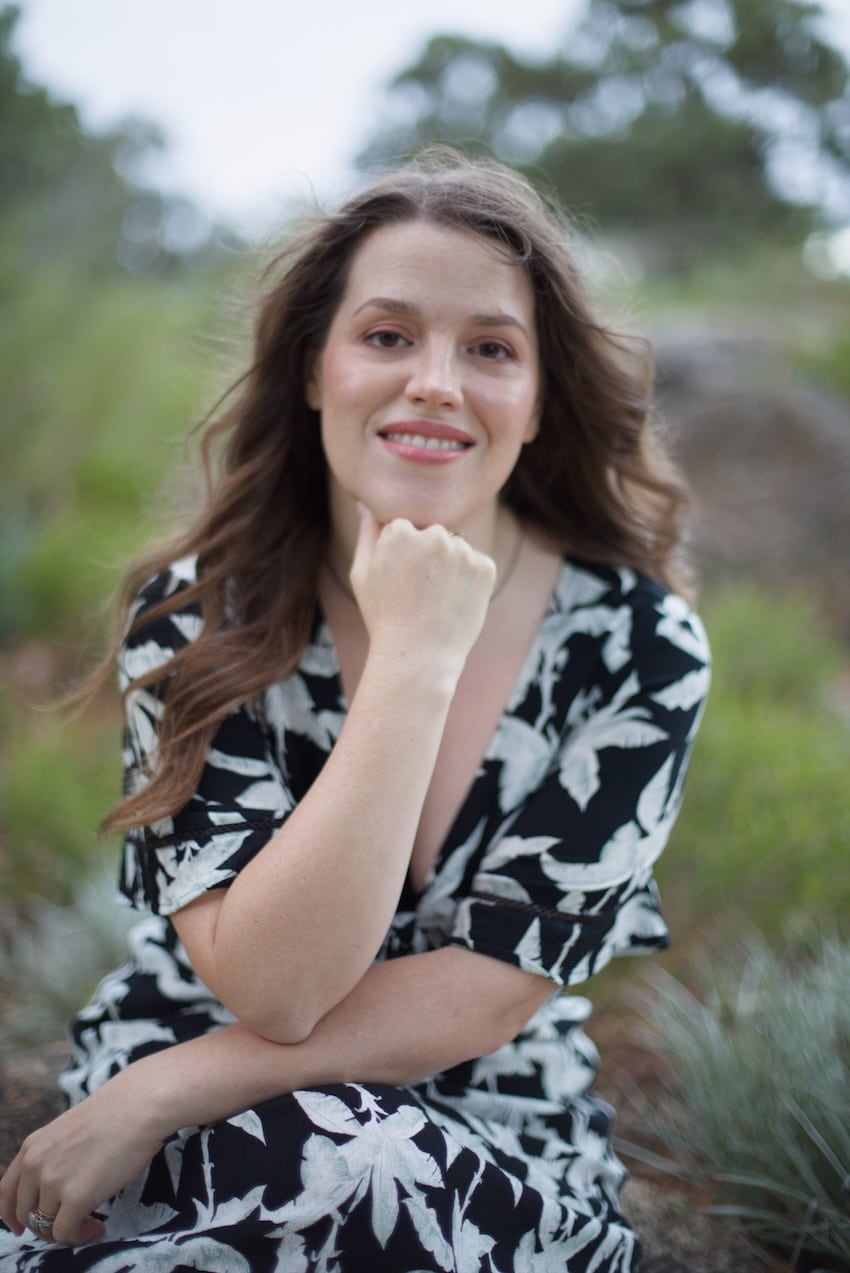
Rebecca Higgie is the author of The Book of After, one of our current book club reads. We got to know Rebecca in this interview:
What do you know now that you didn’t before you began your book?
The Book of the After is a love story that spans millennia. It takes the reader through the fire-fringed flora of the bush, the stillness of the moon, the corridors of ancient temples, the corridors of Parliament. It ponders life after death, features a ‘book within a book’, and has history, science, sex and gunpowder: so many things! The thing I know that I didn’t know before was that I could finish it! At times, I wasn’t so sure.
When readers come to my book, I hope they will take away many things they didn’t know about the climate, history, power and love. I hope, with these things, they will reimagine what our future could be.
What is the most difficult thing about writing a monumental love story?
For me, love always feels monumental. Love for a soulmate. Love for a child. The love I have for my husband and son feels so big that I am often awed by it. I feel how it expands out of me, how it seems to fill the world. In my novel, I tried to capture this by looking at how love echoes across time.
Humans, across millennia, have made the same promises to each other, have uttered “I love you” in a million languages, and felt the same clawing yearning for loved ones lost. My different pairs of lovers, separated by thousands of years, repeat the same declarations of devotion. For me, the challenge was in showing how love is both grand yet common. It is monumental, yet it is everywhere.

Tell us about writing the sex scenes
An important aspect of my book is power and all its complexities. The sex scenes in the book try to centre not just women’s desire but their power. It is not a power that dominates but one that elevates. In a world where political power is often exemplified by a male-centred form of domineering power, I wanted to imagine political power as female-centred and uplifting.
In one of the sex scenes, one of the male characters reflects on how revolution starts in the body. He realises he can access something truly singular when his own desire gets mixed up in how empowered and euphoric his wife feels. The rules of the 16th-century society he lives in can be transcended; the potential for extending that rebellion to the world outside the bedroom is open. As I was writing, I wanted those scenes to be passionate and exciting, but I also wanted them to reflect on those political possibilities.
Did writing this book allay or deepen your anxiety about the state of the world?
In many ways, it deepened my anxiety. I didn’t want to write an anxious book though. I didn’t want to add another dystopia to people’s bookshelves. I wanted to articulate harsh realities, set in the near future of 2050, while also championing hope. I wanted to see our children who march for climate action become our leaders.
I wanted to showcase love – romantic love, parental love, love of country – and put it at the centre of why we as humans are often called to act. In the process of doing all the historical research for the novel, I found constant examples across time of how humans love and make sense of things during times of crisis. So while writing this book has deepened my concern about the state of the world, it has also compelled me to appreciate and fight for the wonderous things worth saving: life, nature and love.
Do you choose to be a writer, or do you think that the writing chooses you?
When I finished The Book of the After, I declared I would never write again. It was an intense, consuming project for over six years, and it took so much out of me. And yet, new characters are already speaking to me. An entirely new world has taken root in my mind, and I know if I don’t write it, it will continue to bother me.
So, I do think the writing chooses me. Stories choose all of us, every time we drift into daydreams or questions of ‘why?’ The difference for a writer is that we then choose to accept the story that has come to us. We put it to paper.
The Book of After by Rebecca Higgie (Fremantle Press, October 2026) is available in all good bookstores and online.

Hi, I’m Anna the Editor of Beauty and Lace.