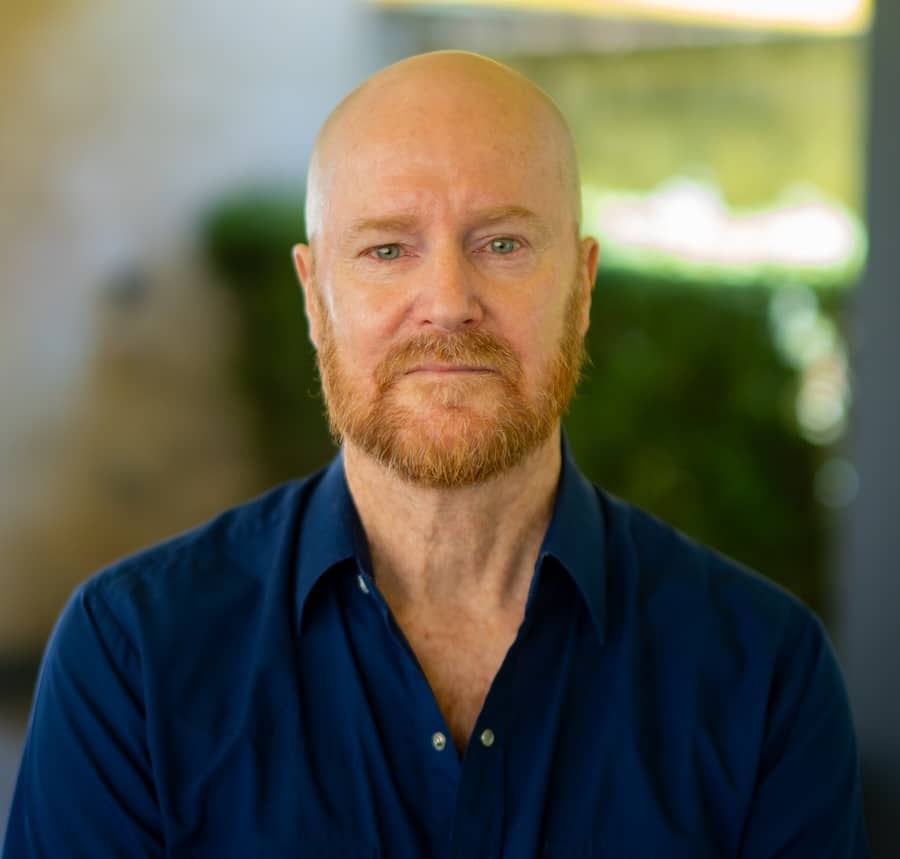
David Whish-Wilson is the author of Free World, one of our current book club reads. You can get to know the author in this interview:
Which of your characters would you least like to be stuck in a lift with?
Strangely enough, even though Free World is set in a prison, the characters I’d least like to be stuck in a lift with are a couple of dodgy prison guards who’re characters in the story. They’re opportunistic types to say the least, and seem to relish in their power.
Which of your characters would you like to invite to a dinner party?
I’ve always had a soft spot for my main characters, and in Free World there are two. The main character Lee Southern would be good to chat to, but most of all I’d love to have dinner with Frank Swann, who’s been in and out of my novels for sixteen years.
He’s seen a lot in his life, and seems a natural storyteller, as is his wife Marion. I think they’d be great company.

Do you have a favourite novel?
I have about thirty favourite novels, but my Dad’s favourite novel is Heller’s Catch-22. As our world becomes more and more absurd, the zone getting flooded daily with acts of madness, hypocrisy and epic moral contradiction, Catch-22’s satire now seems like stark realism.
What is the book you have read more often?
The novel I return to time and again is Randolph Stow’s To the Islands, which won the Miles Franklin back in 1958. Stow writes beautifully about complex issues and his lyricism describing the majesty of the Kimberley landscapes is next level.
What do you think reading crime novels can teach us about the real world?
Crime Fiction is a broad church, but good crime fiction can operate as the social novels of today, able to break down complex issues into narratives that approach these issues through character and action.
I think we learn a lot about ourselves when we’re in extreme situations, and placing characters in extreme situations is a standard trope of crime fiction, thereby revealing some of the truths behind the masks we wear as individuals, but also as communities and nations.
Do you think that writing crime for you is a way of imposing order upon the world?
Great question, but I think of it as the opposite. Crime fiction is terrific at puncturing order and semblances of normality that conceal deeper truths about things. I’ve always liked that JG Ballard quote where he talks about how, because of marketing, advertising, political spin and now AI deep fakes etc, we already live inside a giant novel, full of fictions of every type.
In this kind of world, according to Ballard, it’s the writer’s job to try and reinvent reality using fiction, somewhat paradoxically, as the means.
You have written a number of series now. What is the most difficult thing about writing a series?
The hardest thing for me is even thinking about leaving a series behind. I get a bit attached to my characters and feel bad about neglecting them by not writing more about their lives.
How do you choose which novel to write next?
I’m pretty easy going about what comes next, and tend to let an idea float about for a bit (the novel I’m currently writing has been floating about in my head for nearly a decade) before ‘sneaking up’ on it and sitting down to begin.
I’m not a good planner, so I have to approach a story with a total lack of commitment and yet a deep curiosity, a playful attitude if you like, and hope that the idea has legs.
What did you learn from your times of teaching in a prison setting?
Nothing profound. I learnt that people are people, wherever they are, and that the difference between a person in prison greens and me isn’t a large one necessarily, and (with the exception of psychopaths) is more usually a product of one or two bad decisions.
What was the hardest thing about writing a ‘locked cell’ novel?
As mentioned, I’m not much of a planner or a plotter, and so working in that long tradition of the locked room mystery was somewhat daunting.

Hi, I’m Anna the Editor of Beauty and Lace.